
Welcome to the Mathematical World!
Andrey Markov
Pioneer of Stochastic Processes
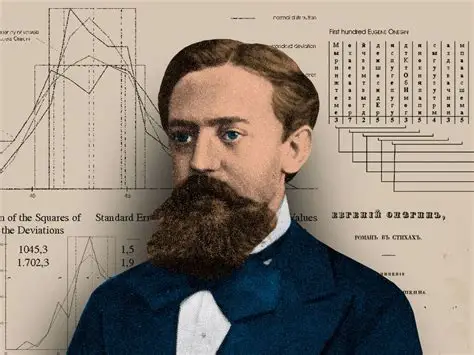
Andrey Andreyevich Markov (1856–1922) revolutionized probability theory by introducing Markov chains, describing processes where the next state depends only on the present state. His work extended Chebyshev’s legacy and created the foundation of modern stochastic analysis.
Contributions
- Markov Chains — Modeled random systems with discrete states, e.g., \[ P(X_{n+1} = j \mid X_n = i, X_{n-1}, \dots ) = P(X_{n+1} = j \mid X_n = i) \]
- Probability Theory — Applied his ideas to linguistic texts, analyzing sequences of vowels and consonants.
- Analysis — Studied convergence and orthogonal polynomials.
Legacy
Markov’s stochastic models are central in computer science, physics, economics, and artificial intelligence. His methods underpin search engines, genetics models, and statistical mechanics.
Facts
- Born in Ryazan, Russia.
- Student of Chebyshev.
- Created the field of Markov processes.
- Analyzed Pushkin’s poem “Eugene Onegin” statistically.

All rights reserved by the Mathematical Unity
Contact: +8801400044645
Email: mathematicalhorse1453@gmail.com
Our Discord Server: Mathematical Unity [Ulus Riyadiyat]